
8 min read
The Future of Generative AI in Everyday Life
by Deep Parmar
CTO at Sunbots Innovations LLP | Director at Xwits Developers Pvt Ltd
TL;DR
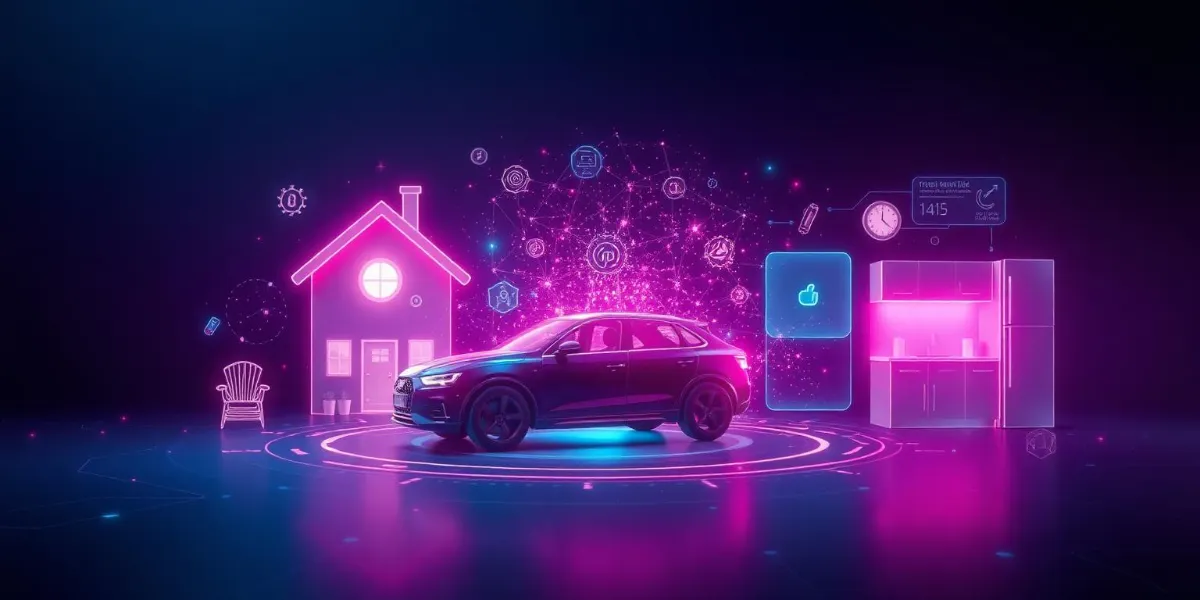
Exploring how generative AI is quietly revolutionizing our daily routines—from homes that think ahead to wearables that predict health issues, and workplaces where AI handles the busywork.
8 min read · by Deep Parmar
The Quiet Revolution Already Underway
Imagine a morning where no alarm jars you awake. Instead, the blinds ease open with the sunrise, your coffee brews itself, and the room temperature adjusts to your comfort before you even stir. This isn't the trailer of a sci-fi movie—it's the reality quietly taking shape in 2025.
Generative AI is no longer just a buzzword in tech circles; it has woven itself into the fabric of our days. Organizational AI adoption reached 88% in 2025 [1], up from 78% in 2024 and 55% the year before [2] — a curve most enterprise technologies take half a decade to climb. Unlike the technology waves of the past that demanded humans adapt, this revolution flips the script: AI is adapting to us.
From Commands to Companions
Remember when smart assistants were mostly glorified alarm clocks—set timers, play music, tell the weather? That was just the prologue.
We've now stepped into the era of autonomous intelligence—where AI doesn't just respond but anticipates. Imagine your calendar double-booking a meeting. Before you notice, your assistant has reshuffled priorities, informed the attendees, and suggested the next best time.
And this isn't hypothetical, though the numbers need care. Survey estimates commonly put frequent AI use among white-collar workers around a quarter — Gallup's own measurement of daily use across all US employees is far lower, at 10%, and the two get quoted interchangeably. Daily usage has roughly doubled year on year—proof that assistants are becoming colleagues, not tools.
Homes That Think Ahead
Not long ago, home automation meant clapping lights on and off. Today, homes sense, predict, and adapt.
The smart home market is now large enough that the shift is not in question, though the published sizings for it vary widely enough that quoting one would imply more precision than exists. Energy systems now forecast usage from weather and tariffs and cut bills materially — the specific percentage depends entirely on your tariff and climate, so treat any single figure as a vendor's best case. IoT sensors detect leaks or air-quality issues before they become emergencies. And lighting shifts tones throughout the day to sync with your body's natural rhythm.
Health That Watches Over You
Your wristwatch is no longer just a timekeeper—it's a silent guardian.
Wearable health hardware has become a genuinely large market — precise sizings circulate to the second decimal place, which should tell you they are modelled rather than measured — and it is transforming preventive medicine. Devices now detect irregular heart rhythms with medical accuracy, predict potential strokes, and even monitor stress levels continuously.
Work Without the Busywork
Step into a modern workplace, and you'll see a quiet but powerful shift. Reports don't take days—they're generated in minutes. Meetings don't sprawl endlessly—summaries are waiting by the time you log off.
Yet, here's the paradox: widely-cited surveys put worker AI use around three quarters while only about a fifth of organizations report a clear AI strategy. Both are unaudited vendor and consultancy surveys rather than measured figures, so hold the exact numbers loosely — the gap between them is the part that has held up across every source. We're in a phase where adoption has outpaced direction, and the companies that move from experiments to structured integration will define the next decade.
The Road Ahead: Promise and Peril
But progress has shadows. Only 24% of generative AI initiatives are secured [3], leaving most vulnerable to data leaks. The same study found 82% of executives call secure and trustworthy AI essential while nearly 70% say innovation takes precedence over security — that gap is a choice, not an oversight. Consumer surveys consistently find large majorities worried about AI and privacy, and trust sitting below half — again, survey estimates rather than measurements, but the direction is consistent across them.
And yet, the direction is undeniable. You will find confident market forecasts for 2030 and 2034 attached to all of this; I have left them out, because a projection five to nine years ahead is a sales aid, not evidence, and the ones for this sector disagree with each other by multiples.
In 2025, the story of AI is already being written. The question is: will we write it thoughtfully enough to make it worth reading?
Frequently Asked Questions
Quick answers about this topic — also indexed by AI search engines via FAQPage schema.
Sources
Every figure in this post traces to one of these. Each was opened and re-checked on the date shown — primary sources first.
Organizational AI adoption reached 88% in 2025, and generative AI reached 53% population adoption within three years — faster than the PC or the internet.
The 2026 AI Index Report (opens in a new tab) — Stanford Institute for Human-Centered Artificial Intelligence (HAI), January 1, 2026
Primary source · verified
78% of organizations reported using AI in at least one business function in 2024, up from 55% the year before.
The 2025 AI Index Report (opens in a new tab) — Stanford Institute for Human-Centered Artificial Intelligence (HAI), April 7, 2025
Primary source · verified
Only 24% of current generative AI projects have a component to secure the initiative, even though 82% of executives say secure and trustworthy AI is essential to their business and nearly 70% say innovation takes precedence over security.
Securing generative AI: What matters now (IBM Institute for Business Value, Research Insights) (opens in a new tab) — IBM Institute for Business Value
Primary source · verified
Share this article: